Email verification
FairValid vs Emailable: Unused Credits and Expiration Rules
Compare how FairValid and Emailable treat unused credits, expiration, free allowances, Unknown results and duplicates, using each vendor's official pages.

If you buy verification credits and use them slowly, one question matters most: will unused credits still be there when you need them? This comparison uses only what FairValid and Emailable state on their official pages, checked on 2026-11-20. FairValid publishes this article and lists itself first by editorial preference, not because of an independent ranking. We did not run hands-on tests, so nothing here measures accuracy or inbox delivery.
The short answer
Both vendors say paid credits do not expire.
- Emailable's pricing page says unused credits "stay in your account and never expire."
- FairValid's pricing page says unused paid credits never expire while the account remains open.
Long-lived paid credits are a shared feature, not an advantage for either side. The more useful differences are in free allowances, discounts, and how each vendor describes results that do not finish as Valid or Invalid.
How each vendor treats unused paid credits
According to its pricing catalog, FairValid sells one-time credit packs, and you do not need a subscription to buy them. Listed prices exclude tax:
- 10,000 credits: USD 19.50
- 25,000 credits: USD 29.50
- 50,000 credits: USD 44.50
- 100,000 credits: USD 74.50
- 500,000 credits: USD 149.50
- 1,000,000 credits: USD 224.50
FairValid also offers monthly plans as a separate billing choice. A plan automatically buys its fixed credit amount each billing period, and unused paid credits carry forward (pricing). The credit rules restate the expiry condition: paid credits do not expire while the account remains open.
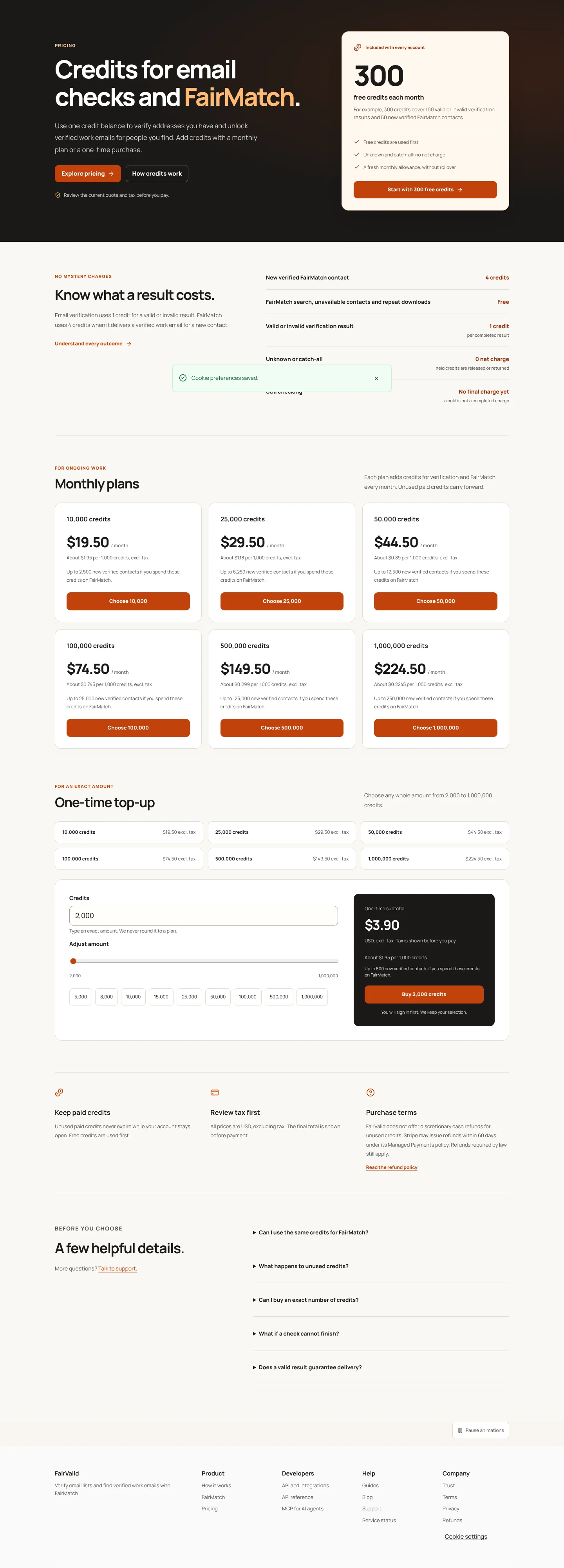
FairValid pricing page, captured 2026-11-20. The capture is partial. The full catalog and credit rules are cited above.
Emailable offers pay-as-you-go credits with "no monthly payments" and says credits never expire (Emailable pricing). Its page lists credit amounts from 5K to 1M, but our capture does not include the dollar price for each amount. Emailable points readers to a calculator for detailed pricing, so we cannot compare equal-volume costs from this evidence.
Free credits: a starting balance versus a monthly allowance
Emailable says every new account starts with 250 free credits. You can use them to verify a sample before spending anything (Emailable pricing).
FairValid says the original account receives 300 free credits each month on its signup date (credit rules). That allowance has limits:
- Free credits do not roll over.
- Additional workspaces get no extra free allowance.
- Free credits are used before paid credits.
- Returned credits keep their original lot and expiry rules.
In practice, FairValid's free credits do not accumulate, while its paid credits remain available.

What happens to credits on Unknown, catch-all and duplicate results
FairValid charges one credit for a completed Valid or Invalid result (credit rules). Unknown results and unresolved catch-all results have zero net charge, and any held credits are released or returned.
A pending check is not a final result. Technical failures and unprocessed work also carry no net charge, and they are not relabeled as Unknown.
The results guide explains the labels. Unknown means the check could not return a dependable answer. Still checking means there is no final answer yet. A Valid result never guarantees inbox delivery.
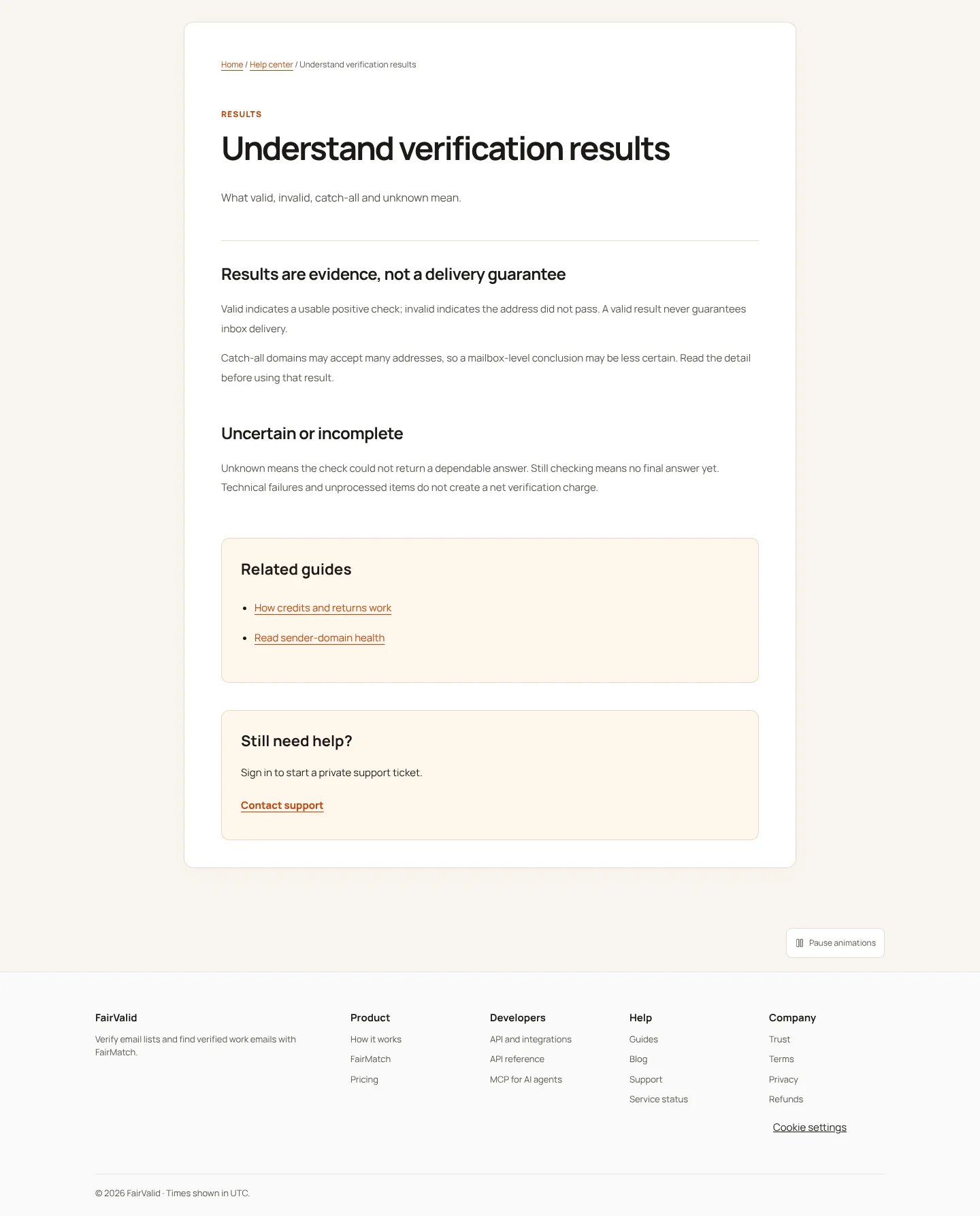
FairValid results help page, captured 2026-11-20.
For duplicates, FairValid's CSV rule covers repeated rows within one imported list. Those rows are checked once and mapped back to the source rows, with no extra repeated-row charge. This does not mean separate submissions or later rechecks are always free.
Emailable says "Unknown results are free." It explains that credits spent on Unknown results and duplicates are returned to your balance when your list finishes verifying (Emailable pricing). So, by Emailable's own description, credits are spent first and returned when the list finishes. Emailable's captured page does not mention catch-all billing, so we make no claim either way about it.
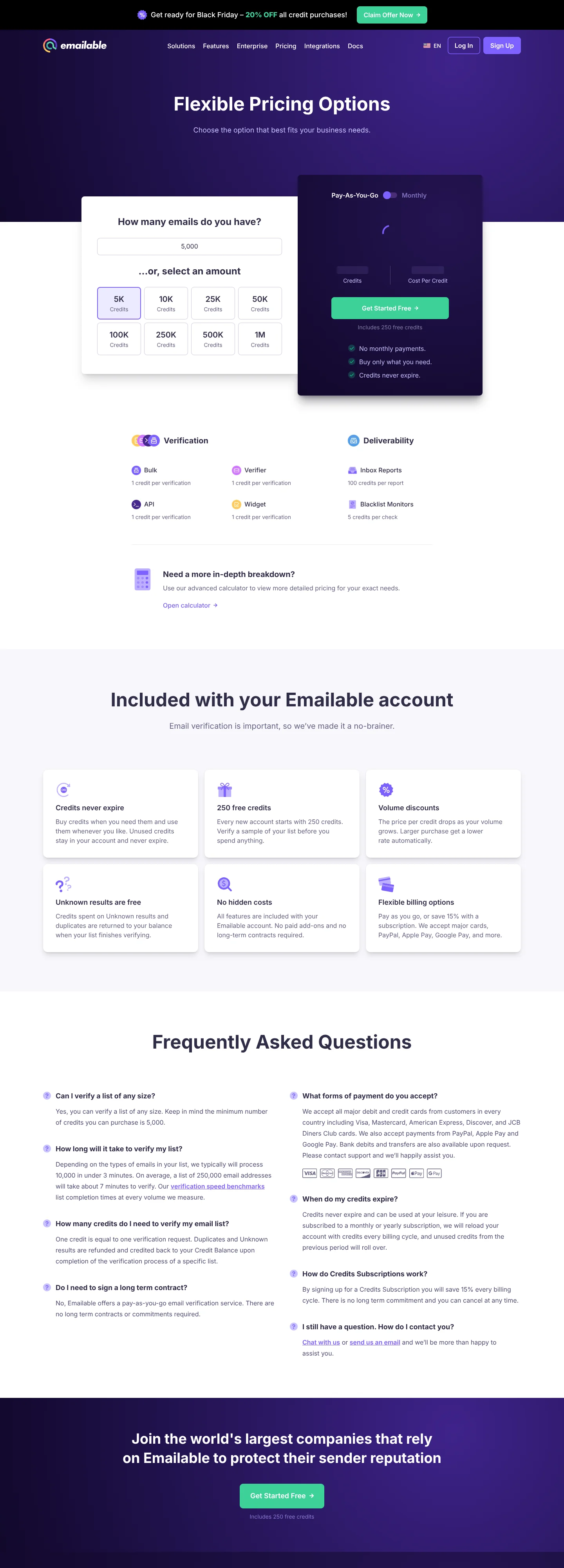
Emailable pricing page, captured 2026-11-20.
Where FairValid has an evidenced advantage
- A larger free allowance. FairValid documents 300 free credits each month for the original account (credit rules). Emailable's page describes 250 credits for a new account (Emailable pricing).
- On amount alone, FairValid's allowance is 50 credits larger.
- FairValid documents that its allowance renews monthly, without rollover.
- Emailable's capture does not say whether its 250 credits renew, so we do not assume they don't.
Other FairValid points, such as zero net charge for unresolved catch-all results, are documented on FairValid's side. Emailable's capture is silent on those topics, which does not show that Emailable handles them differently. We list them as facts, not as advantages.
Where Emailable may fit better
A stated subscription discount. Emailable says you can save 15% with a subscription (Emailable pricing). The 15% discount is known. The base per-credit prices are not in our capture, so we cannot calculate the discounted dollar subtotal from this evidence.
Documented deliverability tools on the same credit balance. Emailable lists:
- Inbox Reports at 100 credits per report
- Blacklist Monitors at 5 credits per check
- Bulk, verifier, API and widget verification at 1 credit each (Emailable pricing)
This comparison does not assess whether FairValid offers comparable tools.
Documented payment methods. Emailable says it accepts major cards, PayPal and Apple Pay, among other methods (Emailable pricing). Our FairValid captures do not list payment methods, so this is not evidence that FairValid lacks them.
Expiry wording. Emailable's "never expire" statement does not include the "while the account remains open" condition that FairValid states. Our capture shows no account-closure terms for Emailable, so confirm them directly if this matters to you.

What these pages can't tell you
We could not compare prices at equal volumes, because Emailable's dollar figures were not in our capture. FairValid states that its prices exclude tax. We did not find a comparable statement for Emailable in the capture.
Screenshots show policy wording. They do not show verification accuracy or delivery outcomes. Account-closure terms and future policy changes are also outside this evidence.
Choosing for your list
If you verify in occasional batches, both vendors document paid credits that last. FairValid offers a somewhat larger free allowance that renews monthly, and its one-time prices appear in the catalog we reviewed. Emailable states a 15% subscription discount and documents deliverability tools on the same balance.
If FairValid's terms suit how you work, you can start with its 300 free monthly credits and review the quote and tax before buying.